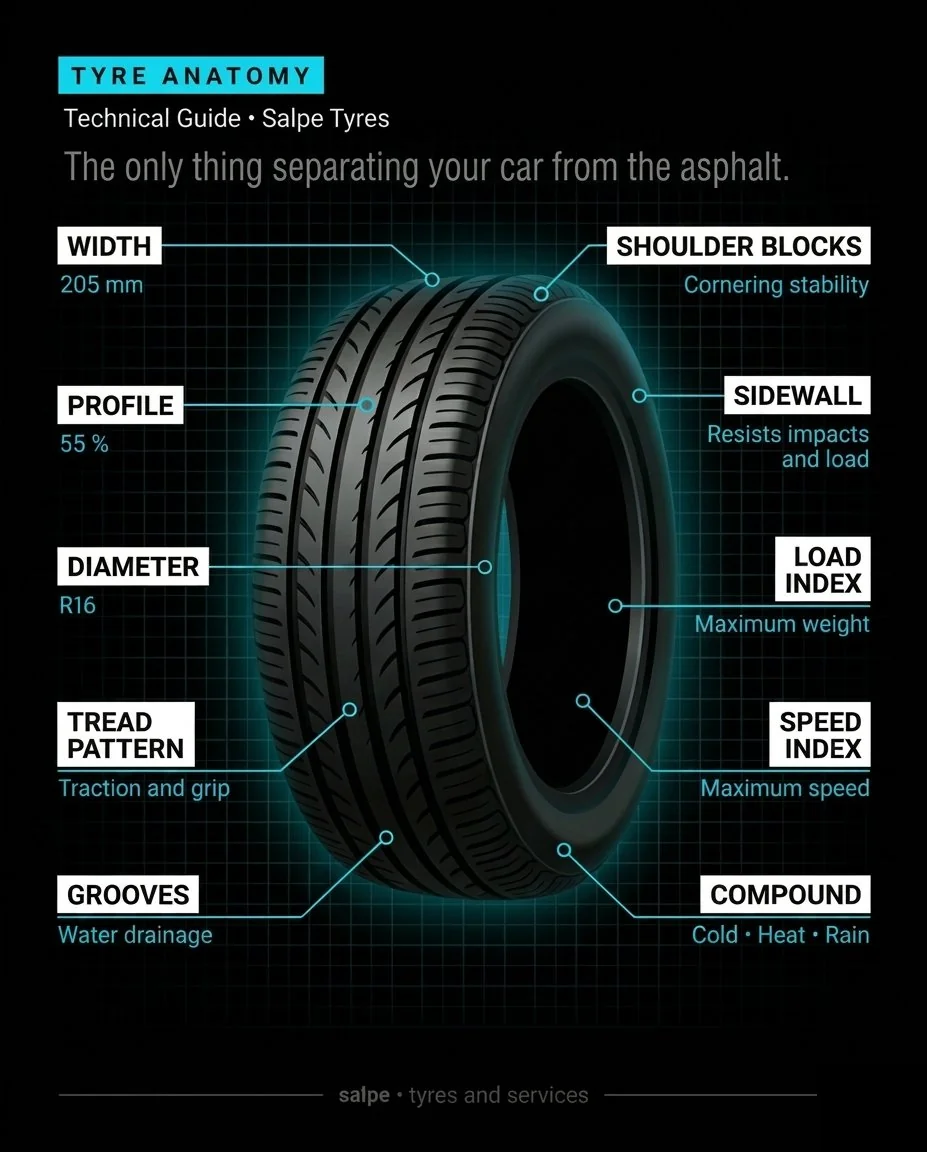
Premium, mid-range or budget tyres: which one actually makes sense for you
Every week somebody walks into Salpe with the same question: "which tyre should I go for?" And behind that question there are usually two equal fears. One, spending too much on a premium tyre they don't need. Two, buying the cheapest one and regretting it when it fails.
We don't sell brand here. We sell judgement. Let's cut through the noise and explain what actually differs between the three tiers and which driver each one is really designed for.
What actually differs between tiers
Every road-legal tyre passes minimum European testing. None is "dangerous" out of the box. What changes between a premium tyre and a budget one comes down to four measurable things:
- Wet braking distance: between a premium and a budget tyre in an 80 km/h emergency stop, you can be looking at 4 to 8 metres difference. That's an entire car length.
- Cabin noise: a premium is usually 2-3 dB quieter. Noticeable on the motorway, less so in town.
- Longevity: a well-maintained premium can reach 60,000 km. A budget tyre, 25,000 to 35,000.
- Fuel consumption: premium tyres have lower rolling resistance and save fuel. Around 2-4% difference.
Premium: who it makes sense for
Premium tyres are designed for people who cover a lot of kilometres each year, mainly on motorways, and for anyone who treats safety as a non-negotiable priority. Families that travel, people who drive for work, cars with mid-to-high power outputs.
Typical brands: Michelin, Continental, Bridgestone, Pirelli, Goodyear. If you cover 25,000 km a year or more, the initial premium cost is repaid in longer life and lower fuel bills.
Mid-range: the balance most drivers need
This is where 60% of the drivers we look after actually fit. Mixed use between town and motorway, 10,000 to 20,000 km a year, no need to push the car hard, no wish to compromise on safety.
Typical brands: Hankook, Kumho, Nexen, Falken. They brake well, last reasonably, run quietly and cost significantly less than a premium. For a normal family with a normal car, a mid-range tyre is almost always the right decision.
Budget: when it genuinely makes sense
Budget tyres get bad press, and part of it is unfair. There are European-homologated budget brands that do the job perfectly well for a very specific use case:
- Second urban car that covers 4,000 or 5,000 km a year.
- Occasional-use work van that barely leaves town.
- Second-home car that goes to the beach for two months a year.
- A car you'll sell within two years, where investing in a premium set makes no sense.
In those cases, doubling your spend on a premium tyre adds nothing real. A well-chosen budget tyre does the job.
The long-term maths
The classic mistake is looking only at the price of the set. A £600 premium set that lasts 60,000 km works out to 1 penny per kilometre. A £300 budget set that lasts 25,000 km works out to 1.2 pence. The per-kilometre difference is tiny, but the premium has given you double the life, better braking and less fuel used along the way.
When the difference really does swing, it swings the other way: a car that hardly moves doesn't justify premium tyres. That's where budget wins.
How we handle this at Salpe
We don't push you to the most expensive tier or to the cheapest. When you come in for tyres, we ask what car you drive, how many kilometres you do a year, where you drive them and what matters to you: wet grip, quietness, longevity or price.
With that in hand, we put two or three real options in front of you, with prices and real advantages. You decide with information, not with fear. You can book a no-obligation consultation.
— The Salpe Team