When to change your tyres: 5 signs you shouldn't ignore
Tyres are the only part of your car that actually touch the road. Everything else — engine, brakes, steering, ABS — depends on those four patches of rubber gripping the tarmac. When a tyre reaches the end of its life, no warning light comes on. It just starts braking worse, especially in the wet, and losing stability in the bends. That's why it pays to read the signs before the problem turns into a nasty moment.
At Salpe we've spent years seeing cars come in with tyres that should have been replaced months earlier. Most of the time it isn't negligence — it's that nobody ever taught the driver what to look for. Here are the five signs we always check during a tyre inspection.
1. Tread depth
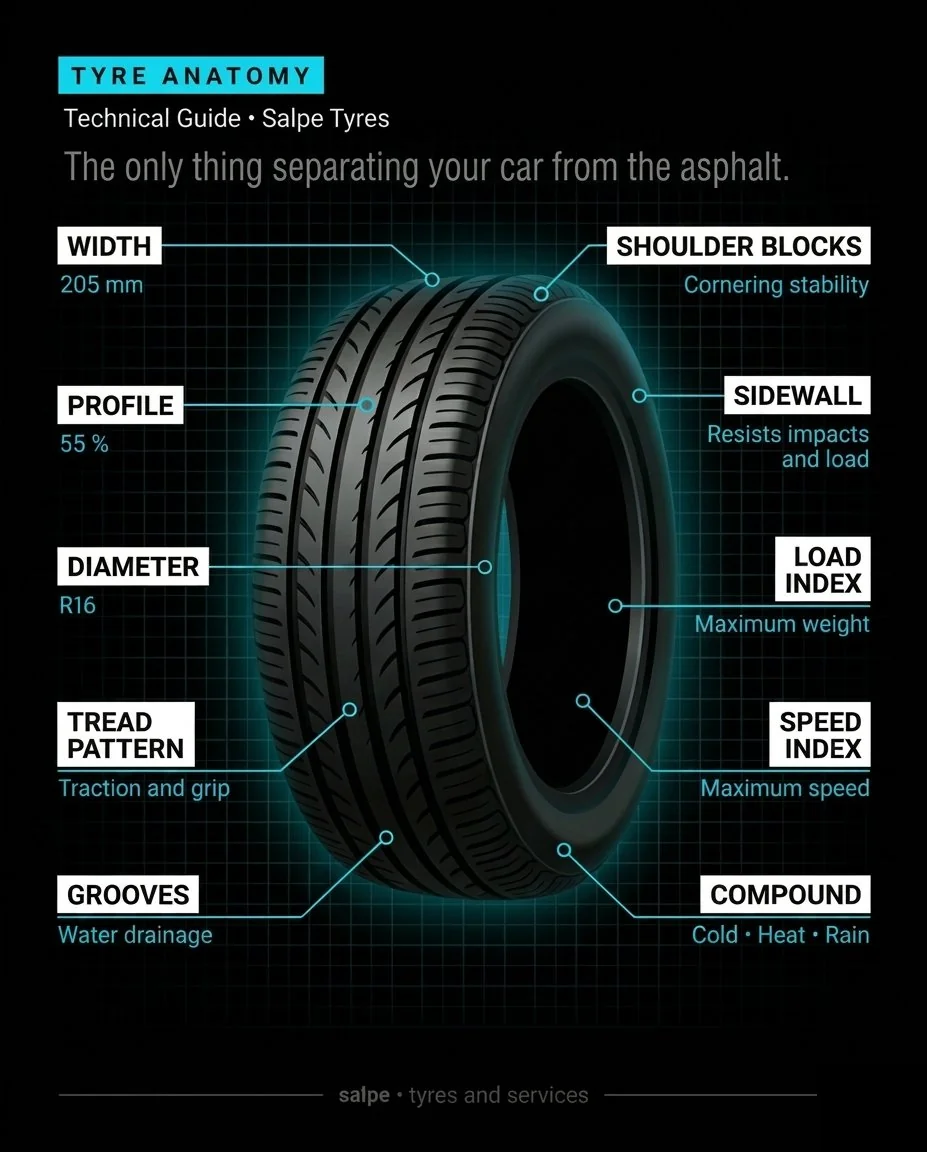
The tread on your tyre isn't decoration. Those grooves are what channel water away when it rains, stopping the car from surfing on top of the surface (what we call aquaplaning). The less tread you have left, the less water the tyre can shift, and the longer your braking distance becomes in the wet.
UK and EU law both set 1.6 mm as the legal minimum. Below that, the tyre is illegal and would fail an MOT. But at Salpe we recommend starting to plan the change from 3 mm, especially if you drive in the rain often or spend a lot of time on the motorway.
2. Cracks and splits in the sidewall
The sidewall is the side of the tyre — the part you can see when the car is parked. Over the years, and with sun exposure, the rubber dries out and small surface cracks appear. At first they look harmless. They're not.
A cracked sidewall is a weakened sidewall. Hit a kerb wrong, drop into a pothole hard, or load the car up for a long trip, and it can blow without warning. This damage cannot be repaired: the tyre has to be replaced. If you can see cracks from outside, get it looked at as soon as possible.
3. Uneven wear
When a tyre wears evenly across the tread, you're getting full value from it. When it wears unevenly, the problem isn't the tyre — it's something else on the car. The typical patterns are:
- Wear only in the centre: tyre inflated above the recommended pressure.
- Wear only on both outer shoulders: pressure too low.
- Wear only on one shoulder (inner or outer): alignment or geometry issue.
- Patchy or step-shaped wear: worn shock absorbers or a wheel out of balance.
Fixing these patterns early can save an entire set of tyres. That's why every time we fit new tyres, we check alignment and balancing. It isn't an extra: it's what makes the tyre last as long as it should.
4. Steering wheel vibration at speed
If you notice the steering wheel starts to shake from around 55 or 60 mph, and it goes away if you accelerate more or if you brake, it's almost always the wheels. It could be a balancing issue (a wheel weight has fallen off) or a tyre that's deformed internally after a hard knock.
It's not just an annoyance. An unbalanced wheel forces the rest of the front end — ball joints, shocks, bearings — to work against itself, wearing them out sooner. Rebalancing costs very little and prevents much bigger bills later.
5. Tyre age
Even with plenty of tread left, a tyre ages. Rubber loses elasticity over the years, even if the car is sitting still. Most manufacturers recommend a proper inspection from 6 years old, and replacement no later than 10 years, even if they look brand new.
The manufacturing date is stamped on the sidewall: it's the last four digits of the DOT code. For example, "3221" means week 32 of 2021. If you've never looked, next time you're near the wheel, have a peek. You might be surprised.
What to do if you spot any of these signs
First: don't panic. None of these signs mean the car will fail tomorrow. What they do mean is that it's time to look at all four tyres calmly and decide what to change, what to adjust and what will last.
At Salpe this check is free. We measure tread depth with a gauge, look for cracks, assess wear patterns and check pressures. We'll tell you what needs changing now and what can wait. No sales pressure: if they'll last, they'll last. You can book online or drop by when you've got 15 minutes.
— The Salpe Team